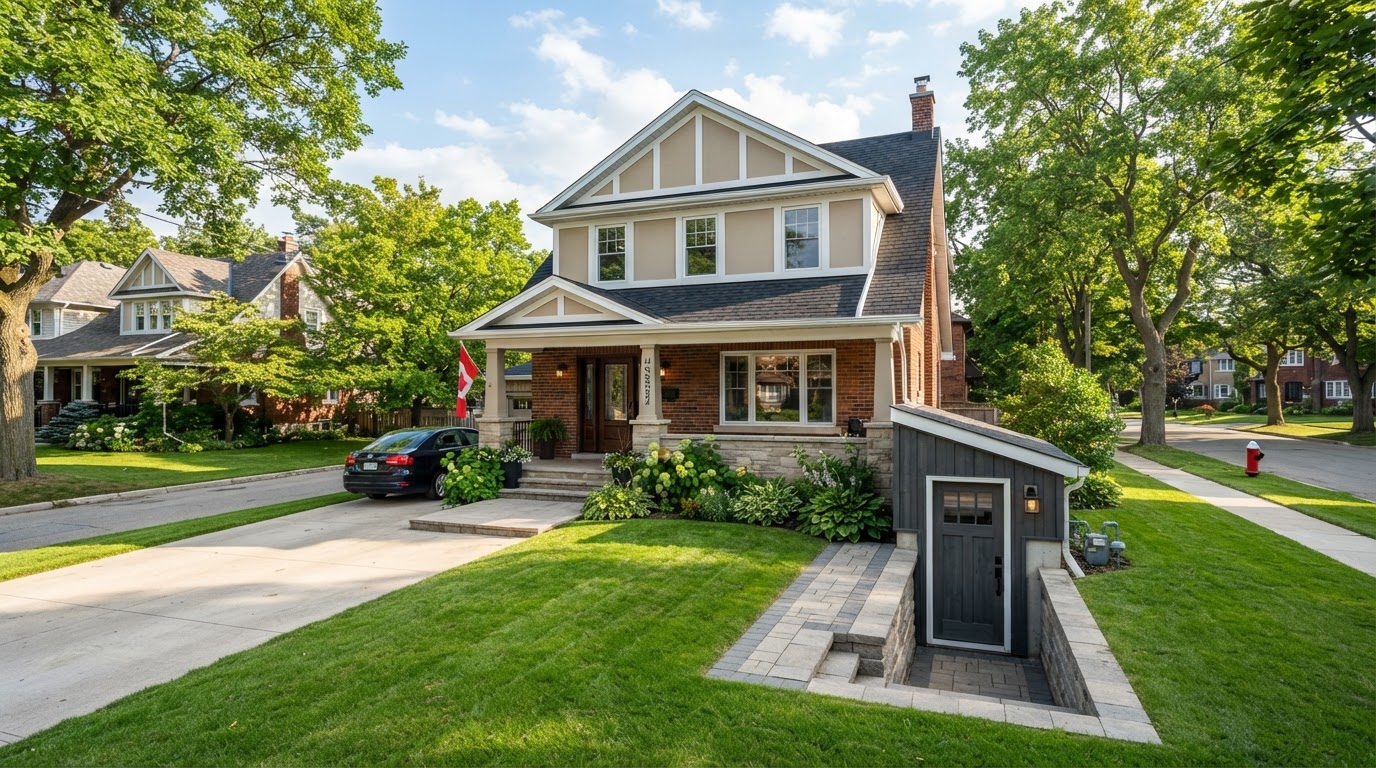
What if the home you thought was too expensive could actually be easier to qualify for because it has a basement apartment?
It sounds backwards, but depending on the lender, that could be the case.
When most people start looking for a home, they focus on the purchase price, down payment, and monthly mortgage payment. But there's another option that doesn't always get considered, especially by first-time buyers.
Buying a home with a rental suite.
A basement apartment, duplex, or property with a separate rental unit could do more than help with your monthly expenses. The rental income may also increase how much mortgage you can qualify for.
And this is where choosing the right lender can make a difference.
How Much Difference Could Rental Income Actually Make?
Let's look at an example using my Max Purchase Price Calculator.
Imagine you're a first-time buyer with a household income of $150,000 and $75,000 available for a down payment.
You find a house with a basement apartment that could generate $1,800 per month in rent.
Using a 30-year insured mortgage qualification scenario, here's how the numbers change:
| Without Rental Income | With Rental Income | |
|---|---|---|
| Annual household income | $150,000 | $150,000 |
| Monthly rental income recognized | $0 | $1,800 |
| Total qualifying annual income | $150,000 | $171,600 |
| Estimated maximum purchase price | $744,528 | $845,860 |
Without Rental Income
Estimated Maximum Purchase Price
$744,528
With Rental Income
Estimated Maximum Purchase Price
$845,860
Potential Additional Buying Power
+$101,332
Illustrative mortgage qualification estimate based on a 6.54% stress-test rate, 30-year insured amortization, $4,500 annual property tax, $150 monthly heating, and a 39% GDS limit. Assumes an eligible borrower and a lender accepting 100% of rental income as an add-back. Actual qualification depends on lender guidelines, mortgage program, debts, and property eligibility.
Why the difference?
In this example, we're using a lender scenario that recognizes 100% of eligible rental income and adds it to the borrower's qualifying income.
The additional $21,600 in annual qualifying income allows the buyer to support a larger mortgage under the lender's debt-servicing calculations.
Of course, not every lender will use 100% of rental income, and these figures assume specific mortgage rates, expenses, and borrower eligibility.
But it demonstrates something important.
You can explore your own numbers using my Max Purchase Price Calculator.
What Makes a Basement Apartment Acceptable to a Lender?
Here's something buyers may not realize.
For example, a basement with its own entrance, kitchen, bathroom, sleeping area, and living space may be acceptable to certain lenders as a self-contained rental unit.
That doesn't mean every finished basement qualifies.
The lender may still need to review the property's layout, condition, appraisal, and any applicable requirements.
It's also important to understand that a lender accepting rental income doesn't automatically mean the basement apartment is legally permitted to be rented. Municipal zoning, building, and safety requirements still apply.
But if you're looking at a property with a separate basement unit that isn't advertised as a legal apartment, don't automatically assume the rental income can't be considered.
It may still be worth reviewing with the right lender.
Not All Lenders Look at Rental Income the Same Way
This is something I think more buyers should know before they start house hunting.
Just because one lender says you don't qualify for a particular mortgage doesn't necessarily mean another lender will reach the same conclusion.
Different lenders have different ways of calculating rental income.
- Income add-back: Some lenders recognize a percentage of the rental income and add it to your qualifying income.
- Rental offset: Other lenders may use eligible rental income to offset certain housing expenses when calculating your debt ratios.
For certain owner-occupied two-unit properties, CMHC's mortgage insurance guidelines even allow up to 100% of eligible gross rental income to be considered in the qualifying calculation.
That doesn't mean every lender will accept 100%, or that every property will qualify under those rules.
A different rental income calculation can sometimes make a meaningful difference in your borrowing power.
How Do Lenders Verify Rental Income?
Here's another question buyers often have: What if the basement apartment doesn't have a tenant yet? Can I still use the rental income to qualify?
The answer is that some lenders will allow it.
There are two common ways lenders may verify rental income, even when the unit is currently vacant.
1. Lease Agreement
If the property already has a tenant, a signed lease agreement can help establish the rental income.
But here's something buyers may not realize.
For example, let's say you're purchasing a property with an empty basement apartment.
You find a tenant who agrees to rent the unit for $1,800 per month, and both parties sign a lease agreement.
Depending on the lender's guidelines, that lease may be accepted to support the rental income used for mortgage qualification, even if the tenant hasn't moved in or started paying rent yet.
The lender may require additional verification, and the lease must reflect a genuine rental arrangement.
2. Market Rent Through an Appraisal
What happens if you haven't found a tenant and don't have a lease agreement?
Some lenders will accept a market rent assessment completed by a qualified appraiser.
The appraiser reviews comparable rental units in the surrounding area, considering factors such as location, size, condition, and features, to estimate what the apartment could reasonably rent for.
For example, let's say you're purchasing a home in Ajax with a vacant basement apartment.
An appraiser reviews similar rental units in the area and determines that the estimated market rent is $1,800 per month.
If the lender accepts that appraisal, the estimated rental income may be used in your mortgage qualification even though you haven't rented out the unit yet.
Depending on the lender, a signed lease for a new tenant or an appraiser's market rent assessment may be acceptable.
What About Your Actual Monthly Mortgage Payment?
Qualifying for the mortgage is one thing. Being comfortable making the payments is another.
Let's go back to the property with the $1,800 basement apartment.
If you're collecting $1,800 per month in rent, that's money coming into your household that could help cover your mortgage and other housing expenses.
But I wouldn't recommend treating the entire $1,800 as guaranteed money in your pocket.
You still need to consider maintenance, insurance, potential vacancies, utilities, and unexpected repairs.
A rental suite can help make homeownership more manageable, but you should still be comfortable with the overall financial commitment.
Before Buying a Home With a Basement Apartment
There are a few things I'd want to establish before you make an offer.
- 1.Will the lender recognize the basement as a rental unit? A separate entrance, kitchen, bathroom, and living space can make a difference. We need to identify which lenders will consider the property and what documentation they'll require.
- 2.How will the rental income be verified? Is there an existing lease agreement? Could you secure a signed lease with a new tenant? Or will we need an appraiser to provide a market rent assessment?
- 3.How much rental income can we actually use to qualify? A lender recognizing 50% of the rent may produce a very different qualification result from one that recognizes 100% under an eligible program.
- 4.Is the unit permitted to be rented? Even if a lender accepts the rental income, the property must still comply with applicable municipal and safety requirements.
- 5.Can you manage the mortgage if the unit becomes vacant? Rental income can help, but you should have a financial cushion in case your tenant moves out or unexpected repairs arise.
You Might Have More Options Than You Think
One thing I've learned working in mortgages since 2011, including my experience in underwriting, is that qualifying for a mortgage isn't always as straightforward as looking at someone's salary and debts.
Sometimes it's about understanding the property, how the income can be verified and calculated, and which lender's guidelines work best for the situation.
A home with a basement apartment also isn't automatically considered an investment property requiring a 20% down payment. If you intend to live in one of the units, eligible owner-occupied properties may qualify for mortgage insurance with less than 20% down.
And even if the basement is vacant or isn't registered as a legal second unit, that doesn't automatically mean every lender will disregard its potential rental income.
That doesn't mean stretching your budget or buying something you can't afford.
It means understanding your options before ruling out properties that could work for you.
Explore your home buying options
Curious How Much You Could Qualify For?
Before you start searching for homes, try my Max Purchase Price Calculator.
Try the Max Purchase Price Calculator
You can compare your estimated purchasing power with and without potential rental income to see how the numbers might change.
The calculator is a starting point. Actual qualification will depend on the property, supporting documentation, and the lender's rental income guidelines.
And if you're looking at a property with a basement apartment or a duplex, I can help you review the financing options, including whether the lender can use a signed lease agreement or an appraiser's market rent assessment.
Gian Manalastas
Mortgage Agent, Level 2
Tribe Financial Group | FSRA #12782
gianm.ca